
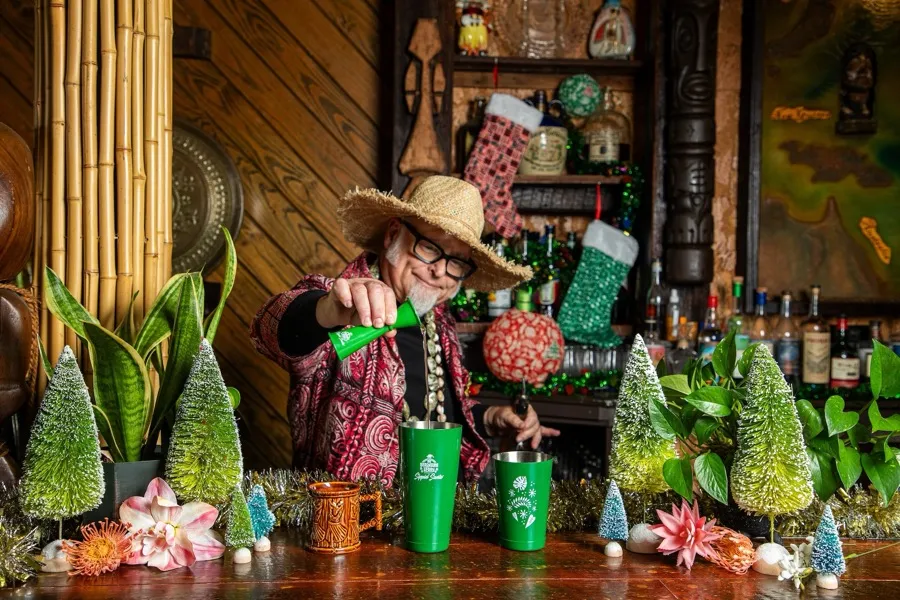
One of Imbibe magazine’s “25 Most Influential Cocktail Personalities of the Past Century” and one of Drinks International’s “100 Most Influential Figures,” Jeff “Beachbum” Berry is the author of seven books on vintage tropical drinks, which for the first time made the lost recipes of Tiki’s mid-century golden age available to the public. Esquire calls Jeff “one of the instigators of the cocktail revolution” and Food & Wine “one of the world’s leading rum experts,” while The New York Times cites him as “the Indiana Jones of Tiki drinks” and The Los Angeles Times as “A hybrid of street-smart gumshoe, anthropologist and mixologist.”
Jeff’s been featured on the Travel Channel’s “Food Paradise” T.V. series, The Discovery Channel, PBS Television and National Public Radio; he’s also been profiled in The Washington Post, USA Today, The New York Times and Wine Enthusiast magazine.
Jeff’s original cocktail recipes have been printed in publications around the world, from Bon Appetit and The Huffington Post to over 20 international recipe books, including the venerable Mr. Boston Official Bartenders Guide.
And now Jeff’s drinks are being served at his restaurant in New Orleans, Beachbum Berry’s Latitude 29, which has won critical acclaim in Esquire, Playboy, The New York Times, The Wall Street Journal, The Boston Globe, The Houston Chronicle, GQ, Travel + Leisure, Town & Country, Southern Living, New Orleans magazine, and the Food Network.
With Martin Doudoroff, Jeff co-created Total Tiki for iPad and iPhone, a drink recipe app which Macworld magazine calls “beautifully rendered and, thanks to Berry’s tireless reporting, impeccably sourced.”
Jeff’s also co-created a line of Tiki barware with Cocktail Kingdom, which Imbibe hails as “especially notable because it revives old styles of essential glassware that were previously almost impossible to find.”
While this is all way too much work for a bum, Jeff is also developing cocktail-focused rum blends for the Hamilton label and tropical bar syrups with Orgeat Works. He’s also been known to leave his hut to lecture across the U.S., Europe, and Latin America.
Greg Boehm of Cocktail Kingdom came up with the Miracle pop-up concept in 2014, and it was also his idea to do a spin-off by combining Christmas with Tiki. He teamed up with me to launch Sippin’ Santa a year later, and we’ve been doing it ever since.
I think the secret to its success —growing from 3 partner bars originally to 68 now, including one in Japan and one in Panama plus several across Canada — is that Christmas makes people happy and Tiki makes people happy, so a mashup between Christmas decor and Tiki decor makes the Sippin’ Santa experience twice as transportive. We’re doubling your holiday fun by combining your Christmas vacation with your tropical island getaway.
On the culinary side, the flavors and aromas of the holidays —such as nutmeg, clove, cinnamon, and allspice — are already ingredients in tropical drinks like the Zombie or Nui Nui. So, the two styles vibe with each other in a natural, unforced way.
By far the biggest challenge with our international growth has been the spotty availability of specific brands of rum, liqueurs, syrups, and bitters in different regions. These days most of my time is taken up not with creating the recipes, but testing and then suggesting substitutions for products that many areas can’t source.
To me Christmas is all about the aesthetic. Just as I love Polynesian Pop design, I love Christmas “Winter Wonderland” decor — the lights, the tinsel, the ornaments — all of it!
On this year’s Sippin’ Santa menu, I’d say the Nui Nui New Year is my favorite holiday cocktail, because it’s a throwback to the classic midcentury, multi-ingredient Tiki ethos with its mix of lime, orange, allspice, cinnamon, vanilla and rum.
When I ask today’s bartenders for their take on a new Tiki drink for my Total Tiki Online recipe website, they submit recipes that call for home-made sage liqueur, sandalwood syrup, prickly pear puree, chocolate-infuse drum, caramelized honey cream, banana flambe mix, orgeat foam… not even the original Tiki bartenders got this into it! So, the short answer is increased complexity incorporating modern 21st Century techniques, plus the use of exotic ingredients that were not available back in the first golden age of Tiki; specifically, East Asian spices plus herbs and fruit purees from the Amazon River basin.
Also, Tiki drinks from the first golden age (1930s-1970s) were almost exclusively rum drinks. Contemporary recipes in today’s neo-tiki bars use different base spirits — a lot more gin and whiskey, cachaca, pisco, tequila and mezcal.
A well-crafted tiki drink juggles sweet and sour, strong and light, fruity and dry, providing new layers of taste that keep the flavor evolving from the opening notes to the mid-palate to the finish. The best of them throw your palate a curve-ball with unexpected, unidentifiable layers of taste, usually accomplished through the sly use of syrups that non-tropical bars tend to ignore (orgeat, passion fruit, falernum, cinnamon, etc.).
As for their roots: There would be no Tiki drinks without Caribbean drinks. Rum, lime, and sugar -- the building blocks of all great Caribbean tropicals from the Daiquiri to the Mojito to the Planter’s Punch -- were the direct inspiration for Donn Beach, who created the first Tiki bar and the first Tiki drinks by using Cuban and Jamaican cocktails as his jumping-off point. They were the foundation for the Baroque drink architecture that he would go on to create.
Screenwriting is all about structure. As I later learned when I got into the drinks world, cocktail recipes are also about structure! The best of them, like plays and screenplays, have a “spine” or “red thread,” an overall theme which every scene must support. Similarly, a drink recipe also must have a spine — a primary base flavor which every ingredient you add must support (i.e., harmonize with and enhance the base). This to me was the key to creating a good recipe, as it was to creating a good script.
The 10-Year anniversary edition of Sippin’ Santa Safari. This edition features a new “afterward” taking readers through the ten years after Sippin’ first appeared: the explosive tiki cocktail revolution that no-one saw coming in 2007, which was aided and abetted by the craft cocktail renaissance that grew on parallel tracks, ending with the opening of amazing new tiki cocktail bars around the world.
There are also 14 additional, previously unpublished vintage Tiki drink recipes. And 10 new recipes from the Tiki Revival around the world.
Cocktail Kingdom published the book in a full-color hard cover edition, with lots of vintage Tiki eye candy to accompany the stories of the people who actually lived Tiki’s golden age.
Expansion is the most exciting thing to me. Bringing on more partners, which means more guests, which means bringing more Christmas cheer and more Tiki tastiness to more people!
My advice would be, don’t do it! Seriously, it’s a lot of work, and you need skilled collaborators to make it happen properly. Lucky for me, our Sippin’ Santa partner bars are carefully vetted by Cocktail Kingdom’s Joann Spiegel, who looks for places that provide great hospitality in an immersive atmosphere, with skilled staffs that have already mastered the art of craft cocktails and won’t be intimidated by any recipes we throw at them.
It’s a veritable Christmas miracle to see how Sippin’ Santa has grown over the years. What this tells me is that we’re making guests happy — and when guests are happy, I’m happy!
Brant Buckley, the creator of Xmas Pop-Up Bars, is a songwriter, guitarist, author and Berklee College of Music graduate.
"We Love Da Bears" is Brant Buckley's newest original release — an energetic Chicago Bears anthem inspired by the excitement, tradition, and passion of Bears football. Blending driving blues-rock guitars, crowd chants, and a classic 12-bar blues foundation with backward blues-inspired riffs, the song was written to capture the electric atmosphere of game day. Recorded in 432 Hz and engineered by Mickey Cushing at Mystery Street Recording in Chicago, "We Love Da Bears" is designed for tailgates, watch parties, sports bars, and every Bears fan ready to cheer on the Monsters of the Midway.
Already generating enthusiastic feedback from listeners, many have described the song as a true Bears anthem. Brant's goal is to have "We Love Da Bears" become part of the Chicago football tradition, played everywhere from neighborhood tailgates to Soldier Field. The song is available on YouTube and all major streaming platforms. If you're interested in featuring the song, please contact Brant below.
In addition, Brant has over 17 years of experience teaching guitar to students aged 7-84. His lessons focus on real musical application, creativity, and personalized instruction. Specializing in Blues, Folk, Jazz, Pop, and Songwriting, Brant offers engaging online guitar lessons via Zoom for students at any skill level.
Brant is also the author of Chicago Blues History: Preserving The Past, a book dedicated to honoring the greatest Blues musicians. His work celebrates music, storytelling, and cultural heritage - the same passion that drives the creation of Xmas Pop-Up Bars.
If you'd like to connect about music, lessons, performances, or writing, Brant would love to hear from you.

© Xmaspopupbars.com, 2024
Website By: Brant Buckley